








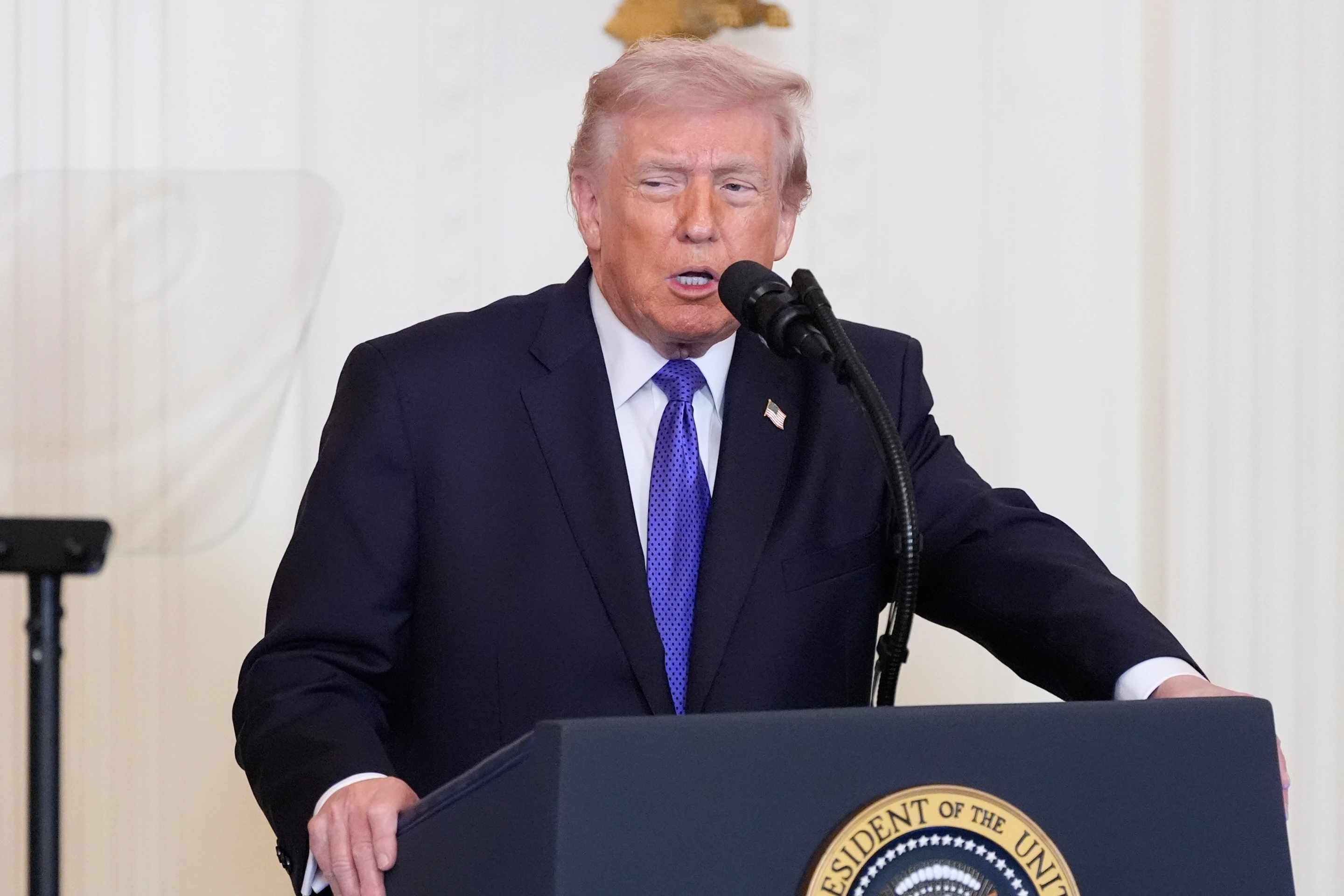
Washington: Congress Debates Trump’s Expanding Military Authority. Throughout Donald Trump's second term, Congress has challenged his military power, first in Latin America and now in the Middle East. The latest test will take place in the Republican-controlled House on Thursday, after the Senate rejected a Democratic proposal to limit Trump's role in the US-Israeli battle against Iran.
Trump, like many of his predecessors, claims wide, even unfettered command over US forces. He authorized boat strikes near Venezuela, a naval blockade, and a military operation to arrest and oust the country's leader, Nicolás Maduro, all of which were considered crimes of war under international law. He made noise about more action in Greenland and Latin America before initiating a massive bombing campaign in Iran.
According to the Constitution, the military reports to the president. However, the document assigns oversight responsibilities to Congress. Trump says he would not sign anything that limits his options, proving to some experts that leadership over a civilian-led military has shifted from its original intent.
Key Developments
"The Constitution gives war powers to two different branches of government," said military history Peter Mansoor, an Ohio State University professor and former colonel in the United States Army. "The pendulum has swung towards the executive," he complained. He argued that "the framers meant for Congress to be the most powerful branch."
Article I, which founded Congress, specifies that parliamentarians "shall have the power... to declare war." Article II, which established the presidency, designates the chief executive as "commander in chief of the Army and Navy." The Constitution also grants Congress power over military funding.
Congress hasn't declared an official state of war since WWII. However, since 1945, American service members have fought and died in large-scale conflicts in Korea, Vietnam, Iraq, and Afghanistan, among other locations.
An Army pilot was injured during the Maduro mission, prompting Trump to award him the Medal of Honor, a legally restricted distinction for conduct taken when fighting a foreign adversary. As of Wednesday, six American service members had killed in the Iran war.
During a Senate debate on Venezuela last month, Sen. Rand Paul, R-Ky., mocked a "elaborate song and dance" and declared it "an absurdity" to suggest that Trump's actions were anything other than waging war. Sen. Tim Kaine, the Virginia Democrat who sponsored the Venezuela and Iran war powers resolutions, claimed the most recent version, which failed 47-53, would prevent a presidential "end-run around the Constitution."
Political / Economic Context
Congress has declared war on 11 countries across five wars. Three declarations were issued in the nineteenth century, two during World War One, and six during World War Two. Each time, the president explicitly requested Congress to intervene, citing a specific threat on the United States or another national interest.
President James K. Polk advocated for the Mexican War, which was mostly about expanding US territory. During the same period, Congress voted numerous times to authorize force without declaring war. Early steps were usually for specific naval activities to protect US commercial interests.
Congress initially chose this path in 1798, and it finally established a blueprint for the post-World War II era. The shift to authorizations rather than formal announcements altered how the United States entered conflicts and contributed to increased presidential authority over military decisions.
The Korean War represented a shift toward presidential power. President Harry Truman won World War II with statements issued when Franklin Roosevelt was president. Then, in 1950, the young United Nations agreed to intervene in Korea and urged member countries for assistance.
Truman, citing the United Nations, sent U.S. forces into a so-called "police action" without first getting congressional approval. Later same year, Congress passed the Defense Production Act, which increased the United States' warfighting capacity. It was an after-the-fact affirmation of Truman's choice, and the statute is still a possible Pentagon tool.
Presidents from Dwight Eisenhower to Gerald Ford presided over what is known as the Vietnam War. Lyndon Johnson persuaded Congress to enact the Gulf of Tonkin Resolution in 1964, which accelerated US involvement. As American casualties climbed, the war became unpopular, but Johnson and then Richard Nixon wielded broad legislative authority. In 1971, Congress revoked the measure, but Nixon refused to withdraw.
As the United States prepared to withdraw from Vietnam in 1973, Congress passed the War Powers Resolution, which imposed restrictions on presidents. The measure required contact with lawmakers and authorized Congress to hold votes limiting military action.
In fact, the War Powers Resolution has not provided an effective check on executive power. Ronald Reagan ordered soldiers to Lebanon in 1982 as part of a multinational peacekeeping mission without first mentioning the resolution. He only consented to legislative authority in 1983, after several US service personnel had died.
Bill Clinton sent US forces to Somalia, Haiti, Rwanda, Bosnia and Herzegovina, Kosovo, and Iraq, demanding funding but not clear authorizations. When urged by legislators to seek approval for Iraqi strikes in 1998, Clinton invoked presidential authority in a manner similar to that of subsequent presidents.
Following the September 11, 2001 terrorist attacks, George W. Bush activated the military. Congress moved promptly to enact a bipartisan resolution authorizing broad anti-terrorism measures. The proposal did not target a single country and first focused on al-Qaida, but it did require Congress to receive updates every 60 days.
In 2002, Bush requested authority to take force against Iraq. The authority had no effective expiration date, allowing military activities to continue for years. Barack Obama took over troops in Iraq and continued the war in Afghanistan during both of his tenure.
Afghanistan remained an ongoing battle between Trump's first presidency and Joe Biden's government. Biden eventually withdrew US troops, bringing an end to the longest war in US history—a combat that Congress had never legally declared.
Why This News Matters
This conversation is all about the ongoing debate in the US over who should be in charge of the military. The Constitution gives Congress the power to declare war, but presidents from both parties have often taken military action without getting permission from Congress. The discussion about Donald Trump's actions toward Iran is part of a larger worry about the balance of power between Congress and the presidency. This position also makes people worry about how to control democracy when American troops are sent to fight in other countries, and how to authorize modern combat when formal declarations of war are becoming less common. The ongoing struggle in the U.S. over military command is at the heart of this conversation. The Constitution gives Congress the power to declare war, but presidents from both parties have often started military operations without waiting for Congress to approve them. The debate over Donald Trump's actions toward Iran shows how worried people are about the balance of power between Congress and the presidency. This situation also raises questions about how democracy works when American troops are sent to other countries and how modern warfare is allowed when formal declarations of war are becoming less common.
What to Watch Next
- Whether the House moves forward with measures to limit Trump’s authority in the Iran conflict
- How the Trump administration responds to congressional attempts to assert war powers
- If lawmakers push new legislation to strengthen the War Powers Resolution
- Whether the Iran conflict expands and increases pressure on Congress to act
- The broader impact on future presidential military decisions and congressional oversight




Leave a Comment
Your email address will not be published. Required fields are marked *
Latamchronicle
Live, Breaking News Theme