








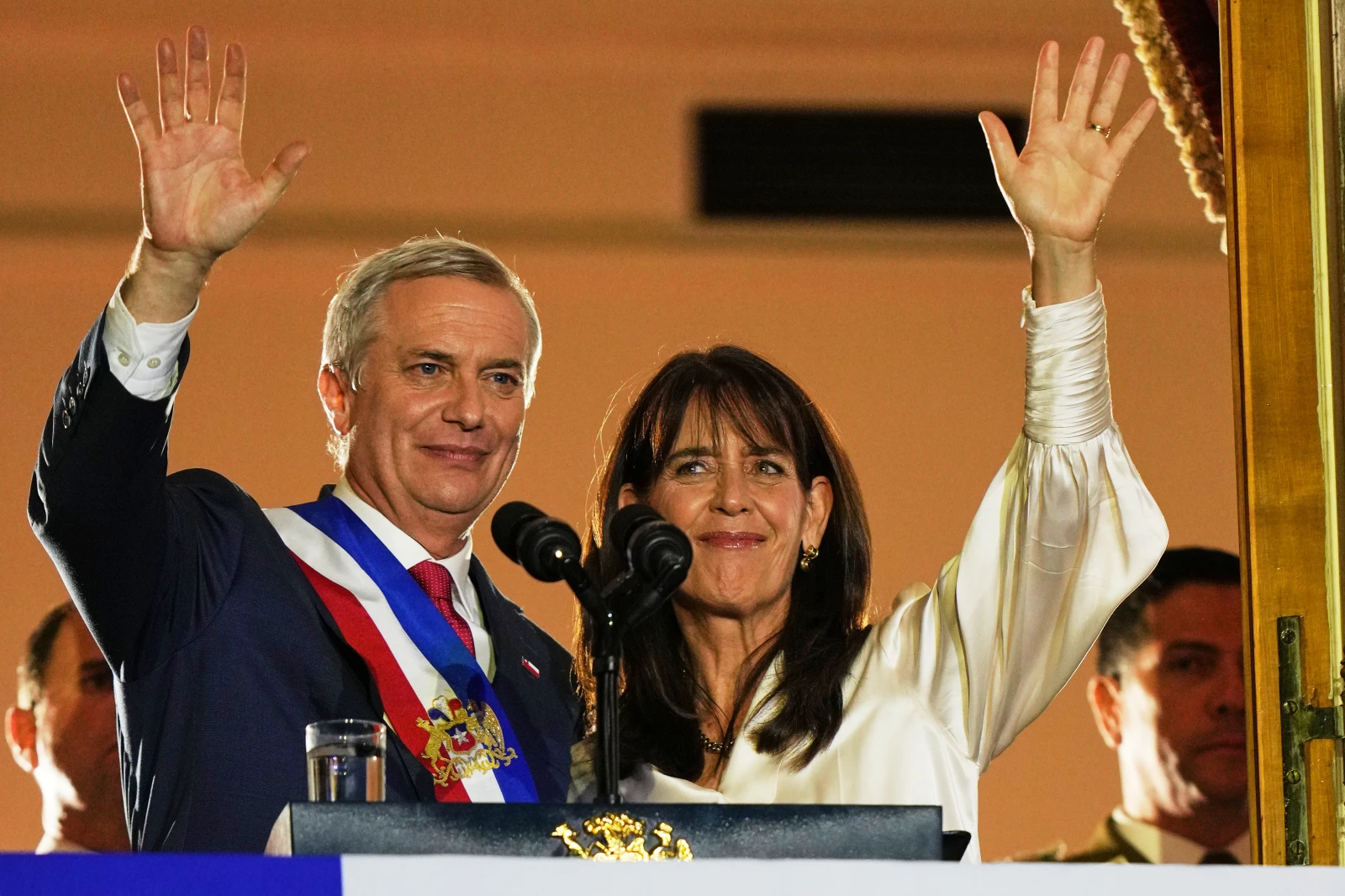
José Antonio Kast Sworn in as Chile’s President
Chile's far-right leader José Antonio Kast was sworn in as president on Wednesday, marking the Latin American country's most severe rightward move since democracy was restored in 1990. Kast and his cabinet took their oath of office at the National Congress in Valparaíso, surrounded by dozens of heads of state, following their resounding victory in the December elections.
The event was attended by Presidents Javier Milei of Argentina, José Raúl Mulino of Panama, Daniel Noboa of Ecuador, and King Felipe VI of Spain. María Corina Machado, recipient of the Nobel Peace Prize, was among the other guests. Presidents Luiz Inácio Lula da Silva of Brazil and Nayib Bukele of El Salvador were among those who did not attend the event. Deputy Secretary of State Christopher Landau led a modest US delegation.
Kast stated in his first speech as president on Wednesday night that Chile had serious foes, including "those who have sown terror in neighborhoods." Kast scored a huge election victory over socialist candidate Jeannette Jara on the promise of combating crime and illegal immigration, similar to his American counterpart, Donald Trump.
"And those who have entered by violating our borders to commit crimes, exploit others, or turn our land into a no-man's land are also adversaries of Chile," Kast declared from the balcony of the La Moneda Palace in Santiago. He went on to say that the government "will not negotiate" with them and that he will pursue and bring them to court.
Public Reactions and Demonstrations
Protests, both supporting and opposing the new president, erupted outside the Congress building in Valparaíso and the La Moneda Palace. Kast's backers brandished flags and held signs proclaiming "Long live Chile" and "President of Change."
"This is a moment for everyone to come together," Melisa Muñoz, a 38-year-old secretary, explained to The Associated Press. She was there to show her support, she said, because most Chileans had cast their ballots for him. Meanwhile, another group of protestors marched against Kast and what they saw as American "imperialism." As a matter of security, police shuttered many subway stations in downtown Santiago.
"With Kast, it's going to be like living back in the '80s," Jeanete Figueroa, 52, an administrator, told AP, referring to the years when Chile was under Gen. Augusto Pinochet's dictatorship. "I lived through it in the '80s, I went out to protest, and now it's going to be exactly the same; I'll go back to the streets."
A Friend of Washington
Chile is the latest Latin American country to vote out its incumbent administration, with voters choosing right-wing candidates from Argentina to Bolivia as Trump seeks to assert American dominance in the Western Hemisphere, punishing competitors while rewarding supporters.
While Kast has avoided speaking on contentious matters at home and abroad, he has made overtures to the Trump administration and hailed the US operation that resulted in the arrest of former Venezuelan President Nicolás Maduro. These signals were heightened lately when Kast unexpectedly terminated the handover process following a disagreement with outgoing President Gabriel Boric over a project to build a submarine cable linking Chile and China. The initiative garnered strong condemnation from the United States and exacerbated diplomatic relations between the Boric administration and Washington.
Under the second Trump administration, the relationship between Chile and the United States soured significantly. Boric didn't mince words when it came to his American counterpart, openly criticizing the Republican's approach and labeling his leadership as that of a "new emperor." Trump, for his part, made his feelings clear, favoring Kast over Boric. He even invited Kast to the recent "Shield of the Americas" event in Miami, which drew a crowd of right-wing leaders from the region, including Bukele and Milei.
Organized Crime and Immigration in Focus
Kast's defeat in the 2021 presidential race came at the hands of Boric. Chileans, at that point, were largely put off by Kast's stance on abortion and same-sex marriage, along with his embrace of Pinochet's past.
Fast forward four years, and his tough-on-crime and immigration policies resonated with around 60% of the electorate. This change unfolded in a country already wrestling with a rise in organized crime and where Boric's pledges had failed to materialize, leaving many disappointed.



Leave a Comment
Your email address will not be published. Required fields are marked *
Latamchronicle
Live, Breaking News Theme