



At Least 66 Dead After Colombian Air Force C-130 Crash in Amazon
A Colombian Air Force C-130 crash in the Amazon kills at least 66 people, raising concerns over aircraft safety and military infrastructure.





 WORLD
WORLDDeadly Military Plane Crash in Colombia
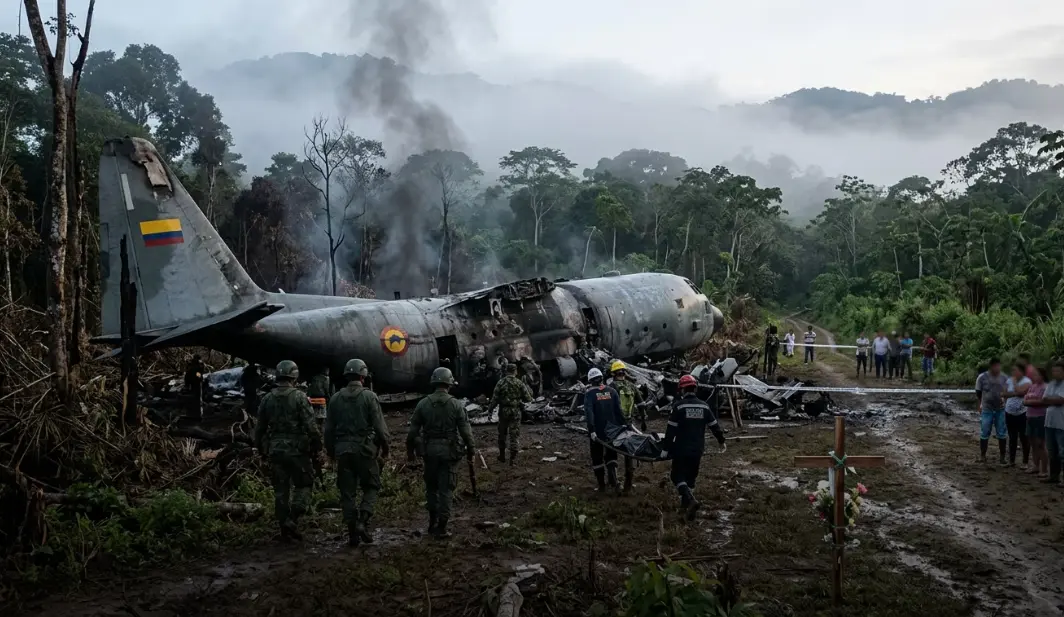
On March 23, 2026, a Lockheed Martin Hercules C-130 met with tragedy near Puerto Leguízamo, deep in the southern Amazon, not far from the Peruvian border. The aircraft was transporting a group of people, numbering between 121 and 128, which included army personnel, Air Force members, and police officers. The crash resulted in the loss of at least 66 lives, with many others injured and four individuals unaccounted for. Those who survived were swiftly moved to hospitals. While some had only minor injuries, others needed immediate airlift to more advanced medical facilities. During the initial rise, the aircraft crashed just a few kilometers from the airport. According to reports, it dropped altitude quickly before colliding with dense jungle terrain and catching fire. This is now considered the deadliest crash in Colombian Air Force history. Rescue activities were immediately begun, with military forces and local citizens working together to evacuate the injured and recover victims.
Why This News Matters
This crash is more than just a sad accident; it's a warning. The tragic crash of a Lockheed Martin C-130 Hercules, claiming numerous lives, immediately brings to mind urgent concerns. Questions about safety protocols, the age of the aircraft, and the adequacy of current measures to protect military personnel are all brought to the forefront. Many people in Colombia want to know not only what happened but also if it could have been stopped.
Casualties, Survivors, and Rescue Operations
The tragedy took a heavy toll, with the number of fatalities climbing to 66 as search and recovery efforts persisted. The initial numbers were smaller but nearly doubled as more bodies were found from the wreckage. Among the 125+ individuals on board were roughly 114 soldiers, 11 crew members, and at least two police officers. Dozens of survivors, estimated to be between 57 and 77, were rescued, with many suffering from varied degrees of injury. The remote wilderness where the crash occurred complicated efforts to help. Residents were quick to act, helping get the hurt to nearby clinics before the military could reach the scene. The local medical facilities quickly became overwhelmed, prompting officials to arrange airlifts for the most critically injured to bigger hospitals. Meanwhile, search teams kept looking for the four still unaccounted for and also worked to recover the bodies from the wreckage.
Possible Causes and Investigation
The inquiry into what went wrong is still underway. Preliminary reports, however, hint at potential mechanical issues with the aircraft soon after it left the ground. Witness testimonies and preliminary results suggest that the plane collided near the end of the runway, with one wing apparently striking a tree before plummeting to the ground. Officials have ruled out an attack by illegal armed groups, despite the region's history of conflict. The aircraft, a C-130 Hercules variant flown by Colombia since the late 1960s, reportedly underwent maintenance and was part of a modernization effort that included equipment transfers from the United States. Lockheed Martin has claimed that it will help with authorities during the probe. The final cause decision will be based on ongoing technical examination and flight data recovery.
Government Response and Political Reactions
Colombian President Gustavo Petro called the crash a needless tragedy and blasted bureaucratic bottlenecks that have hampered efforts to replace the country's outdated military fleet. He underlined the importance of accountability, adding that administrative failures may have contributed to the disaster and warning that authorities who refuse to act should be fired. The nation mourns, and calls for a comprehensive probe have come from political figures and those vying for the presidency. Critics point to budget constraints, aging equipment, and a lack of investment in military infrastructure as key contributors to the disaster. This event has also sparked discussion about Colombia's dependence on older aircraft and the speed of defense modernization, intensifying the pressure on the government to implement reforms without delay.
Context and Broader Implications
This event highlights persistent problems within Colombia's military aviation, especially concerning aging aircraft and the logistical challenges of operating in isolated regions. The C-130 Hercules has been a staple of military operations for decades, but it has recently come under fire due to safety concerns. The recent incident, echoing a similar one involving a C-130 in Bolivia, brings up wider concerns about aviation safety in the region. Colombia's military strategy, its procurement processes, and the future of its operational security are likely to be influenced by the ongoing investigations. International observers are also watching closely; aviation regulators and industry experts are particularly interested in the unfolding situation.
What to Watch Next
The investigation's findings will be crucial, particularly regarding any potential mechanical issues or maintenance needs. Furthermore, the government's reaction will be worth watching. Will this actually lead to safer, more advanced military aircraft, or will it simply fuel further disputes?
Related: Read also: Gray Whale Found Dead After River Journey, Venezuela and Colombia Cancel Border Summit, and DEA Names Colombia's Petro a Drug Trafficking Target.
Focuses on international relations, global trade, and geopolitical developments.

Just for You
 WORLD
WORLDLatin American Business Travel Spending Surges Toward Record $67.7 Billion Amid Regional Corporate Expansion
Business travel spending in Latin America is forecast to hit a record $67.7 billion in 2026, an 11% annual inc…
 WORLD
WORLDPan American Health Organization Validates Chile as First South American Nation to Eliminate Dog-Mediated Rabies
PAHO and WHO officially certified on September 29, 2026, that Chile has eliminated dog-transmitted rabies, bec…
 WORLD
WORLDUnited States Revokes Visas for 27 Latin American Officials Under Shield of the Americas Anti-Corruption Mandate
The U.S. State Department revoked visas for 27 Latin American officials and family members from Bolivia, Colom…
 WORLD
WORLDEighteen Suspects in Jovenel Moïse Assassination Extradited to United States as Judicial Cooperation Expands
Eighteen key suspects in the 2021 assassination of Haitian President Jovenel Moïse were extradited to the Unit…
Comments (0)
Sign in or create an account to leave a comment.