








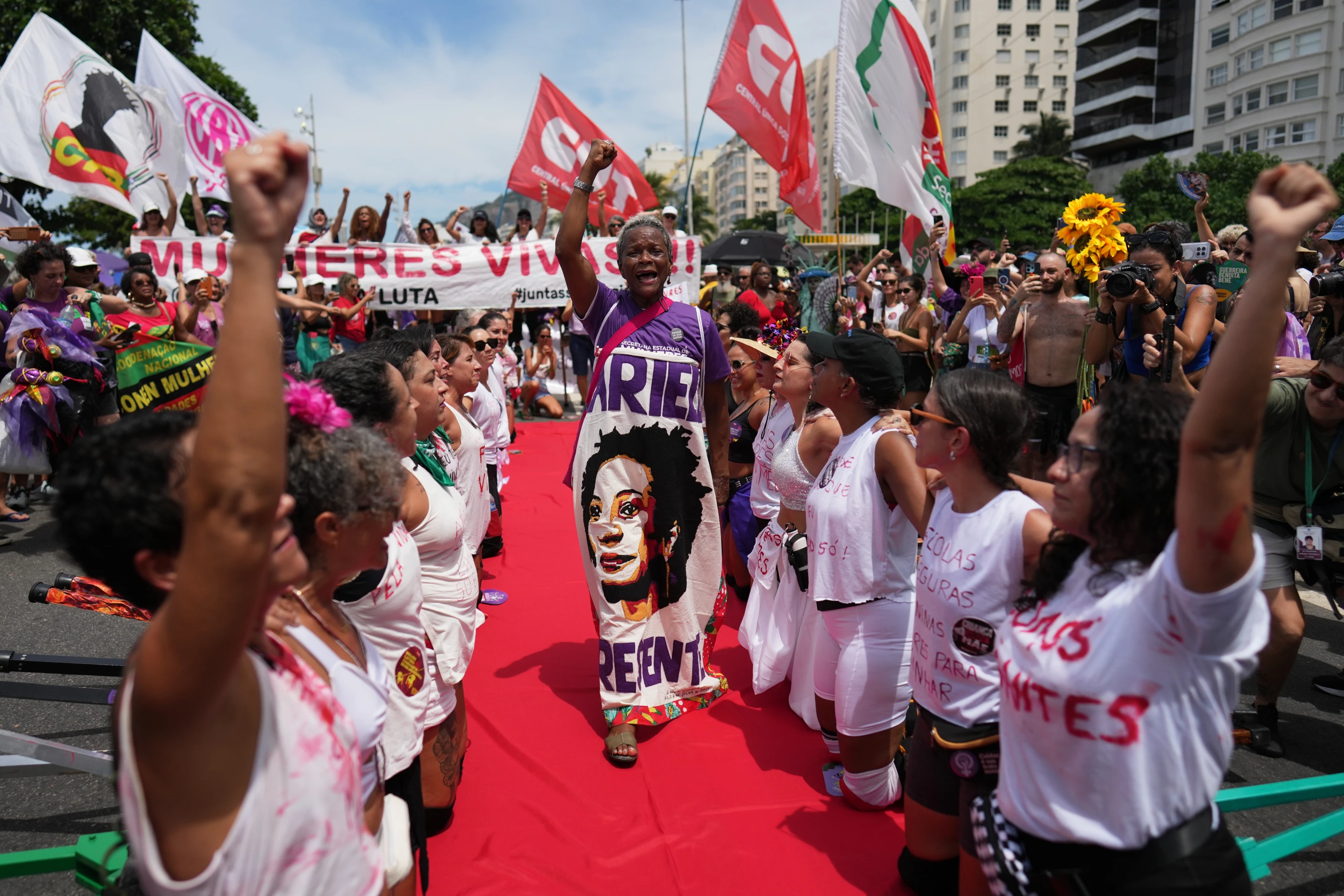
RIO DE JANEIRO (AP) — Sunday's marches in Brazil for International Women's Day were a rallying cry against gender-based violence, spurred by the latest case to anger the country, the alleged gang rape of a 17-year-old girl in Copacabana. The investigation in Rio de Janeiro's famous oceanfront neighborhood began in January but grabbed national attention last week when four suspects turned themselves in to authorities. Police described the incident as a gang rape, adding fuel to the fire in a country where complaints of violence against women have increased in recent months, spurring widespread rallies and a rush of digital activism. At least 15 protests were planned across the country, with organizers demanding the protection of women's lives and an end to femicide.
Rio's Civil Police said the four young males in pretrial detention would be prosecuted for rape, while a fifth suspect, a minor, brought himself in on Friday to face an equivalent charge under juvenile law.
Authorities filed an arrest warrant for the kid after learning of his alleged involvement in another incidence of sexual violence with a similar dynamic to the Copacabana incident, according to an email from the Rio state prosecutors' office. Lawyers for two of the accused have denied any wrongdoing, while lawyers for the other three have yet to publicly comment on the issue. A police investigation discovered that in January, the victim received a message from a classmate at her elite school asking her to a friend's house. Once entering the residence, she was led to a room and shut in with the suspects, where she was sexually abused and subjected to physical and psychological trauma, according to a police statement dated March 4. Earlier this week, security camera footage of the men entering and leaving the scene of the suspected incident went viral on social media.
The case drew more public attention after the father of one of the suspects was named undersecretary for governance and compliance at Rio's state social development and human rights department. Following the claims against his son, the official was removed from his position, according to a decision published Wednesday in the state government's official gazette.
Rising Violence Against Women in Brazil
Ordinary Brazilians, women's rights organizations, and official figures like ministers Anielle Franco and Sônia Guajajara turned to social media to condemn the incident. "It's impossible not to be outraged when a 17-year-old young woman is subjected to such brutal sexual violence," said Racial Equality Minister Franco, the sister of dead councilwoman Marielle Franco, as she called for huge protests on International Women's Day, March 8. Violence against women in Brazil is on the rise, with 1,568 documented femicides in 2025 alone, a 4.7% increase over the previous year and more than three times the amount in 2015. Other crimes against women, such as threats, stalking, psychological violence, bodily injury, rape, and attempted femicide, have also steadily increased in recent years, according to a think tank report released ahead of March 8. "Women's bodies continue to be seen as someone else's territory, which can be threatened, assaulted, sexually violated, and murdered," according to the report.
Government Response and Calls for Continued Mobilization
Following a series of high-profile cases last year and the accompanying demonstrations, Brazil's government tightened security procedures. Earlier this year, President Luiz Inácio Lula da Silva's administration declared a multipronged effort to eradicate femicide that included executive, legislative, and judicial powers. Brazil's government took immediate action, launching a national task force to carry out roughly 1,000 arrest warrants for known offenders. They also rolled out an electronic tracking system for individuals under protective orders and sent out 52 mobile units to help women facing violence.
Isadora Vianna, a sociology researcher at Rio de Janeiro State University, sees these government actions as carrying considerable symbolic weight. They signal that the authorities find violence against women unacceptable. However, she argues that more needs to be done in terms of both prevention and support. Vianna also stressed the need for more stringent internet rules to curb the rapid spread of misogynistic material. Tatianny Araújo, a 47-year-old women's rights activist, has been involved in more than thirty International Women's Day events. This year, however, she feels a distinct shift, largely because of the recent, high-profile sexual assault allegations, including the alleged gang rape in Copacabana. Her 13-year-old son attends the same high school as two of the suspects, who are in the process of being expelled. “We feel bad, we cry, and we’re consumed by rage and by pain,” Araújo said. "At the same time, we can't stop. We have to mobilize and do something."



Leave a Comment
Your email address will not be published. Required fields are marked *
Latamchronicle
Live, Breaking News Theme