







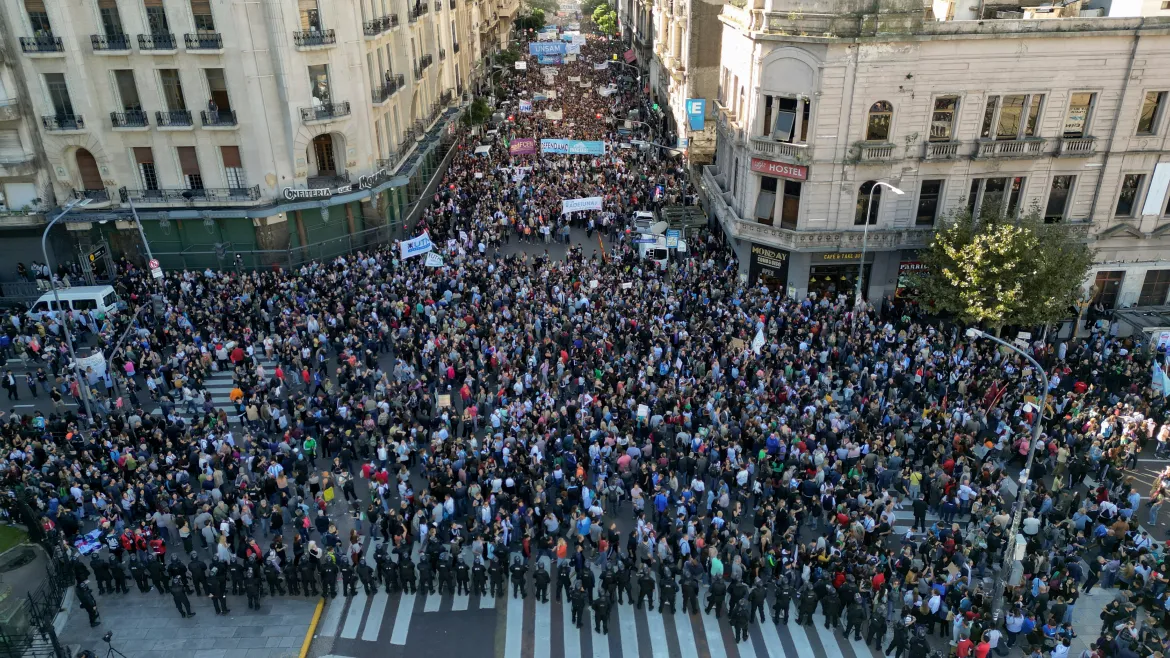
Buenos Aires: Tens of thousands of Argentines marched through major cities on Tuesday in one of the largest demonstrations against President Javier Milei’s government this year, protesting deep funding cuts to the country’s public university system.
Massive crowds gathered in downtown Buenos Aires and other cities nationwide, waving banners, chanting slogans, and accusing Milei’s administration of undermining one of Argentina’s most important public institutions.
The demonstrations highlighted growing anger over the libertarian president’s austerity measures, which critics say are damaging education, scientific research, and opportunities for middle-class families already struggling under the country’s economic crisis.
Argentina’s public university system has long been considered one of the country’s proudest achievements. Public universities have been tuition-free since 1949 and have produced generations of professionals, scientists, doctors, lawyers, and five Nobel Prize winners.
For many Argentines, access to free higher education represents a symbol of social mobility and national identity.
Tuesday’s protests showed how deeply concerns over education funding resonate across political and social groups, with students, professors, labor unions, retirees, and families joining the marches.
Universities Face Deep Financial Pressure
The protests were triggered by mounting concerns that public universities are being pushed toward financial collapse under Milei’s economic policies.
Last year, Argentina’s Congress approved legislation aimed at increasing university funding and raising teacher salaries to match soaring inflation levels. However, Milei’s government has refused to implement the law fully and is instead challenging it in court.
The administration argues that the legislation does not explain how the state would finance the spending increases during a period of strict fiscal austerity.
Government officials insist spending cuts are necessary to stabilize Argentina’s economy after years of high inflation, debt crises, and currency instability.
But university leaders and education unions say the cuts are already causing severe damage.
According to Argentina’s main university teachers’ federation, professors have effectively lost around one-third of their salaries in real purchasing power since Milei took office in late 2023.
Inflation continues to erode incomes, while many universities struggle to cover basic operational expenses such as electricity, maintenance, research funding, and classroom supplies.
The rector of the prestigious University of Buenos Aires, Ricardo Gelpi, warned that hundreds of professors and researchers have already abandoned the public system for private universities or better-paying jobs.
Gelpi said at least 580 professors in engineering and scientific departments have left due to declining wages and worsening working conditions.
University administrators fear that the continued loss of researchers could weaken Argentina’s scientific and technological development for years to come.
Students and Teachers Lead Nationwide Demonstrations
Protesters filled streets carrying signs defending public education and criticizing Milei’s economic policies.
Many accused the government of deliberately trying to dismantle the public university system.
“University is a source of pride for us. It is the best thing we have,” said 24-year-old law student Sol Muñíz during the march in Buenos Aires.
Others directed anger toward top government officials, particularly Cabinet chief Manuel Adorni, who has recently faced scrutiny over alleged lavish spending and corruption accusations.
One protest sign asked: “How much does Adorni cost us?”
The protests also reflected broader dissatisfaction with Milei’s administration as Argentina continues facing economic hardship.
Although Milei initially gained popularity for promising to eliminate inflation and reduce state spending, his approval ratings have recently declined amid falling wages, rising unemployment, and reduced economic activity.
Critics argue that austerity measures are disproportionately hurting workers, students, and public institutions while failing to generate immediate improvements in daily life.
Government Dismisses Protests as Political
Milei’s administration pushed back strongly against the demonstrations.
Alejandro Álvarez, the government’s undersecretary for university policies, described the protests as “completely political” and accused opposition groups of using universities to attack the administration.
Government officials insist that universities have received additional resources to help offset higher operational costs, although unions and administrators say the increases remain far below inflation.
The legal dispute over university funding is expected to eventually reach Argentina’s Supreme Court.
Protesters on Tuesday called on the court to defend public education and reject attempts to weaken the funding law passed by Congress.
“Listen to the outcry throughout the country’s public squares,” some demonstrators chanted outside government buildings.
The conflict over university funding has become one of the most politically sensitive battles facing Milei since taking office.
Public Universities Seen as National Symbol
Public education occupies a unique place in Argentina’s national identity.
Unlike many countries in the region, Argentina built a strong tradition of accessible higher education that allowed generations of middle-class and working-class students to attend university without paying tuition.
Universities such as the University of Buenos Aires gained international recognition for producing leading academics, scientists, economists, and public figures.
Many Argentines fear that prolonged budget cuts could permanently damage that legacy.
Analysts say the protests also reflect a wider ideological clash between Milei’s libertarian vision of reducing the state and Argentina’s long-standing support for public institutions.
For many demonstrators, defending universities goes beyond education policy and represents resistance against broader austerity measures affecting healthcare, social programs, and labor protections.
Tuesday’s nationwide marches demonstrated that universities remain one of the few issues capable of uniting broad sectors of Argentine society.
As economic pressures continue mounting, the standoff between Milei’s government and public universities is expected to remain one of the country’s most significant political flashpoints in the coming months.