






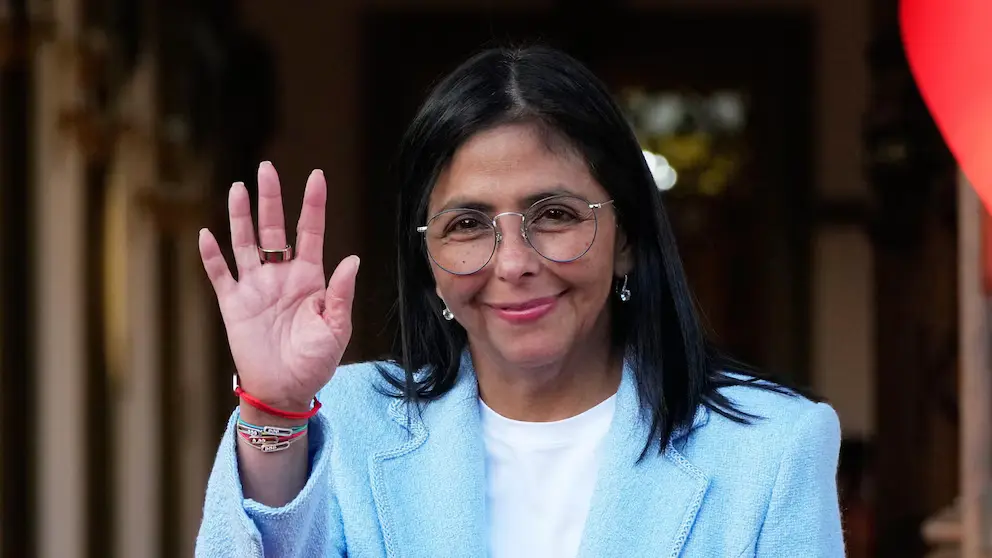
The Hague: Venezuela’s acting President Delcy Rodríguez rejected comments by U.S. President Donald Trump suggesting Venezuela could become the “51st U.S. state,” insisting Monday that the South American nation would continue defending its sovereignty and territorial integrity.
Rodríguez made the remarks while speaking to journalists at the International Court of Justice in The Hague during the final day of hearings in the long-running territorial dispute between Venezuela and Guyana over the resource-rich Essequibo region.
“We will continue to defend our integrity, our sovereignty, our independence, our history,” Rodríguez said. “Venezuela is not a colony, but a free country.”
Her comments came after Trump reportedly told Fox News that he was “seriously considering making Venezuela the 51st U.S. state.”
The White House later declined to provide details about Trump’s remarks, although spokesperson Anna Kelly praised Rodríguez for cooperating closely with the United States.
US and Venezuela Maintain Dialogue
Rodríguez acknowledged that communication between Caracas and Washington remains active despite ongoing tensions.
She stated that Venezuelan and U.S. officials are currently working on “cooperation and understanding” following the dramatic political changes earlier this year.
Rodríguez assumed power in January after a U.S. military operation in Caracas resulted in the capture of former President Nicolás Maduro, who was later transferred to New York to face drug trafficking charges.
Maduro has pleaded not guilty.
Essequibo Dispute Returns to International Court
The remarks also came during ongoing legal proceedings concerning the disputed Essequibo territory, a vast region that makes up roughly two-thirds of neighboring Guyana.
The area is rich in oil, gold, diamonds, timber, and other natural resources, and offshore oil discoveries in recent years have significantly increased tensions between the two countries.
Guyana currently produces around 900,000 barrels of oil per day from offshore fields near Essequibo, transforming the small South American nation into a major energy producer.
Venezuela, meanwhile, argues that the territory historically belonged to it during the Spanish colonial period.
The current border was established in 1899 through an arbitration ruling largely favoring Guyana, then under British colonial rule.
However, Venezuela insists that a later 1966 Geneva agreement effectively invalidated that earlier ruling and requires the dispute to be resolved through political negotiations.
Rodríguez Accuses Guyana of Undermining Negotiations
During the hearings, Rodríguez argued that Guyana undermined diplomatic mechanisms by bringing the matter before the International Court of Justice in 2018.
She accused Guyana of seeking a judicial ruling shortly after major oil discoveries were announced off the Essequibo coast.
“This change was not accidental,” Rodríguez told the court. “It coincided with the discovery in 2015 of the oil field that would become world-renowned.”
Guyana’s government maintains that the International Court of Justice should uphold the 1899 arbitration ruling that established the current border.
Last week, Guyanese Foreign Minister Hugh Hilton Todd told judges that the dispute has threatened Guyana’s sovereignty since the country’s independence.
Regional Tensions Remain High
Tensions over Essequibo intensified in 2023 after Maduro threatened to annex the territory by force following a Venezuelan referendum on incorporating the region as a Venezuelan state.
Although Rodríguez did not directly address the referendum during Monday’s remarks, she reiterated that negotiations — not court rulings — remain the appropriate path toward resolving the dispute.
The International Court of Justice is expected to take several months before issuing a final legally binding decision.
Venezuela has repeatedly stated that participating in the hearings does not mean it recognizes the court’s authority over the dispute.