







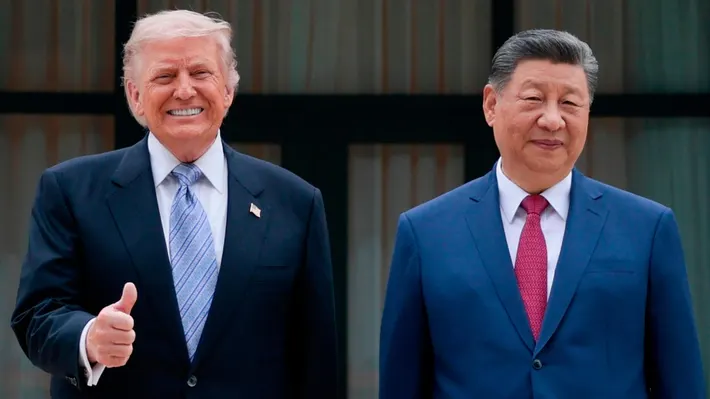
Beijing: U.S. President Donald Trump and Chinese President Xi Jinping concluded high-level talks in Beijing on Friday, with both leaders claiming progress toward stabilizing relations between the world’s two largest economies despite continuing disagreements on major geopolitical issues.
The summit marked the end of Trump’s three-day visit to China, where the two leaders held extensive discussions covering trade, Taiwan, Iran, energy security and global economic stability.
Xi welcomed Trump to Zhongnanhai, the historic leadership compound in Beijing, for the final phase of the summit. The leaders walked through the gardens and held talks over tea and lunch alongside senior aides and translators.
Trump described the meetings as productive and praised Xi personally after the discussions.
“It’s been really a great couple of days,” Trump told reporters before departing Beijing.
Xi called the summit a “milestone” and said the two countries had established a “constructive, strategic, stable relationship.”
Taiwan Remains a Major Point of Tension
Despite the optimistic public statements, major divisions remain unresolved between Washington and Beijing.
Taiwan once again emerged as the most sensitive issue during the talks.
According to Chinese officials, Xi warned Trump during private discussions that mishandling Taiwan-related tensions could push the two nations toward “clashes and even conflicts.”
China considers Taiwan part of its territory and has repeatedly warned against foreign support for the self-governed island.
U.S. Secretary of State Marco Rubio later stated that American policy toward Taiwan remains unchanged and warned that any attempt by China to seize Taiwan by force would be “a terrible mistake.”
The United States recently approved an $11 billion weapons package for Taiwan, the largest military support package ever offered to the island.
Trump has also publicly pressured Taiwan to increase its defense spending and contribute more toward its own protection.
Iran Conflict Overshadows Diplomacy
The Iran war and the continuing instability in the Strait of Hormuz also dominated the summit discussions.
Trump and Xi reportedly agreed that the strategic waterway must reopen fully to stabilize global energy supplies and reduce economic pressure on international markets.
Before the conflict escalated, roughly 20% of the world’s oil shipments passed through the Strait of Hormuz.
Trump stated that both leaders shared concerns over Iran’s nuclear ambitions.
“We don’t want them to have a nuclear weapon,” Trump said during the summit.
However, important disagreements remain over how to pressure Tehran into ending the conflict.
The United States has accused Chinese firms of assisting Iran through oil purchases and satellite support, while China has criticized the American and Israeli military campaign against Iran.
White House officials believe Beijing could use its economic influence as Iran’s largest trading partner to encourage negotiations.
At the same time, China reportedly opposed any proposals involving tolls or restrictions on shipping through the Strait of Hormuz.
Trade and Economic Issues Still Unresolved
Trade relations also featured heavily during the summit.
Trump said “fantastic trade deals” had been discussed, though he did not provide detailed information about any finalized agreements.
According to Trump, Xi signaled that China could purchase 200 Boeing aircraft from the United States.
The two sides also discussed expanding Chinese purchases of American agricultural products including soybeans and beef.
U.S. officials additionally pushed for greater access to Chinese markets for American financial companies such as Mastercard and Visa.
The White House is also reportedly interested in establishing a formal bilateral trade board aimed at managing ongoing commercial disputes between the two countries.
Despite these discussions, analysts noted that many structural trade tensions remain unresolved, including tariffs, technology restrictions and market access issues.
Symbolic Diplomacy and Strategic Messaging
Chinese officials organized an elaborate farewell ceremony for Trump before his departure from Beijing.
Foreign Minister Wang Yi personally accompanied Trump to the airport, while schoolchildren waving American and Chinese flags lined the route near Air Force One.
Trump appeared impressed by Xi’s hospitality throughout the visit, especially the historic Zhongnanhai compound and its landscaped gardens.
He described Xi as “warm” but also “all business” during a television interview conducted before leaving China.
The summit highlighted the increasingly complex relationship between Washington and Beijing as both governments attempt to balance strategic rivalry with economic interdependence.
While both sides publicly emphasized stability and cooperation, deep divisions over Taiwan, Iran, trade and military influence across Asia continue to shape one of the world’s most consequential diplomatic relationships.