








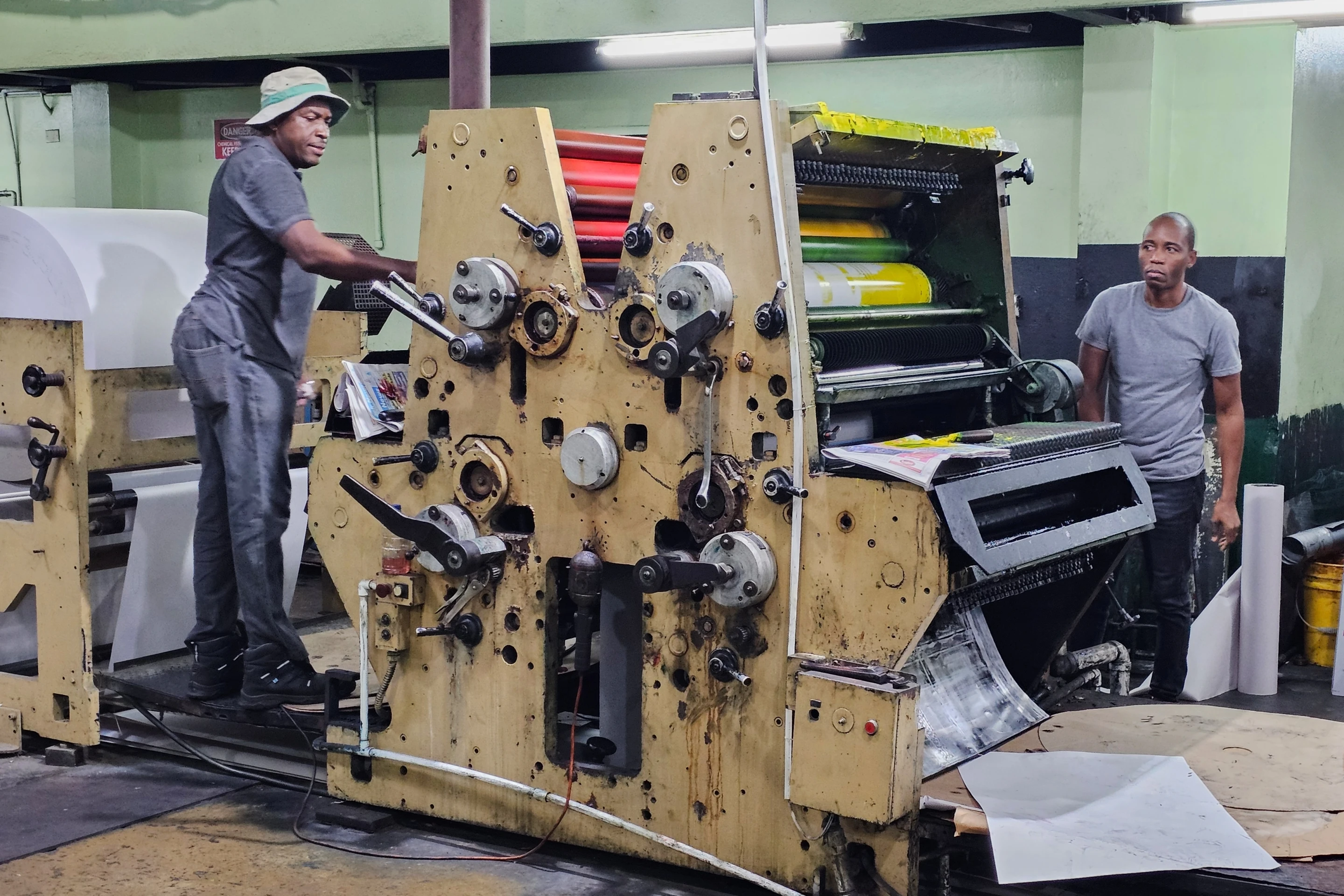
Closure of Legacy Caribbean Newspapers Amid Social Media Shift
Carlon Augustus, who grew up in Trinidad and Tobago, remembers reading the newspapers his grandparents bought every day. He is 32 years old and claims he uses social media to stay up-to-date on current events. It is important to him to have access to real-time information. "Today, everything is on social media. Whatever happens today, you won't have to wait until tomorrow to acquire the papers," he explained.
Media owners blame changing reading habits, such as Augustus', for the closure of two heritage newspapers in the Caribbean this year: Guyana's Stabroek News and Trinidad and Tobago's Newsday. Trinidad & Tobago's Newsday stopped publishing, both in print and online, back in January. Judy Raymond, the newspaper's former editor-in-chief, voiced her sadness about it. This situation is a setback for the country and its democratic principles, especially considering the growing importance of credible and professional media, particularly in today's world, which is heavily influenced by social media.
Caribbean newspapers, chronicling a wide array of events from political scandals and unrest to catastrophic storms and compelling human-interest stories, have been grappling with the same challenges as print media everywhere. They're trying to keep readers engaged, even as they barely make a dent in the dominance of social media and digital outlets.
Kiran Maharaj, president and cofounder of the Media Institute of the Caribbean, noted the added difficulty of these closures. Both publications were independently owned, which allowed for a diversity of perspectives and made them less vulnerable to the influence of advertisers or those in power. "You're seeing a contraction of that now," she observed.
Stabroek News and Its Role in Promoting Free Speech
Stabroek News printed its final edition on Sunday and ceased online publication. It was founded in November 1986, a year after its founder asked Guyana's then-president whether he would approve the establishment of an independent newspaper. Guyana was six years away from holding its first free and fair elections in nearly three decades.
Stabroek News became known for its solid, independent journalism, setting high standards that were emulated throughout the region. It solicited opinion pieces from prominent literary figures, including Guyanese poets Martin Carter and Ian McDonald. The report also examined the crucial general election of October 1992, an event that signaled the dawn of a new democratic age. After years of oppressive governance, the publication evolved into a space for open expression. "Its letters page provided perhaps the most open and democratic public forum in Guyana," noted lawyer Christopher Ram in a recent piece published in the newspaper.
"Over time that column became something of an informal national meeting place where academics, trade unionists, political figures, public servants, businesspeople, and ordinary citizens debated, as equals, matters of public importance. "Stabroek News once held the crown as Guyana's leading newspaper. The nation still boasts three other papers: one is government-owned, and another has strong ties to the party in power. A third recently began surveying its website visitors about paying for online access.
Early Ward, a retired 76-year-old manager from the beverage industry in Guyana, voiced his disappointment over Stabroek News's decline. "I've been reading newspapers since the 50s, and I still prefer the feel of one in my hands, something I can carry around and read whenever I want," he said. These days, Ward finds himself turning more to television and social media for his news.
Newsday’s Influence in Trinidad and Tobago
Trinidad and Tobago's Newsday debuted in 1993, offering to reach the most remote areas on the twin-island nation, which nonetheless has two long-standing rivals: the Trinidad and Tobago Guardian and the Trinidad Express.
The daily appealed to blue-collar workers and quickly became a household brand, with journalists scooping other news sites on stories and MPs citing its articles in parliament.
Newsday was noted for its coverage of Tobago, the smaller and less developed of the two islands, as well as for amplifying the voices of those in need, according to Raymond, who was editor-in-chief from 2017 to 2022.
She found one of the most fulfilling aspects of her job at the publication was helping people. "They're in a tough spot," she explained. "The system hasn't come through for them, and they don't have anyone else to rely on."
Decline of Print Media and Financial Pressures
From the 1970s to the mid-1990s, newspapers in the Caribbean had strong financial backing and were status symbols, according to journalist Wesley Gibbings, vice president of the Jamaica-based Media Institute of the Caribbean. "People would be seen walking with a physical copy of newspapers," he told me. "It was almost a prestigious thing to be the one with the newspaper."
Gibbings explained that Big Tech platforms, notably Google, began garnering advertising content and money while mining mainstream media content. "The danger signs have been up for a very long time," he told me. "We're in a pivotal moment, and the downturns will keep coming." Grant Taylor, the managing director, offered an explanation: the demise of Daily News Limited, the publisher of Newsday, was the result of a perfect storm of challenges. He noted a staggering 75% decline in print advertising revenue over the past decade.
Raymond, instrumental in launching Newsday's digital bureau back in early 2018, believed the paper could have been more aggressive in diversifying its online revenue. Looking back, she questioned whether a digital-only model would have been the right call. Yet, considering the closure of Loop News, a regional online news venture, she acknowledged that going fully digital wouldn't have guaranteed Newsday's survival.
The owners of Stabroek News claim the government chipped in a paltry $7.5 million to cover a $90 million debt stemming from advertising services provided the previous year. Yet, the newspaper pointed to factors beyond unpaid bills or a cut in government advertising. "Readership has changed dramatically," they explained, "and fewer people are purchasing print copies or even subscribing online."
In a letter to Stabroek News, Lurlene Nestor voiced her sadness at the paper's closure. She observed, "particularly considering Guyana's present circumstances, where allegations of pervasive public corruption abound, and the nation's crucial resources—gold and oil—appear to be either squandered or exploited for political advantage."
Anand Persaud, the editor-in-chief of Stabroek News, echoed these sentiments while also highlighting the paper's accomplishments.
"We leave at this stage," he told me, "because we want to make sure our independence is not on the line."




Leave a Comment
Your email address will not be published. Required fields are marked *
Latamchronicle
Live, Breaking News Theme