







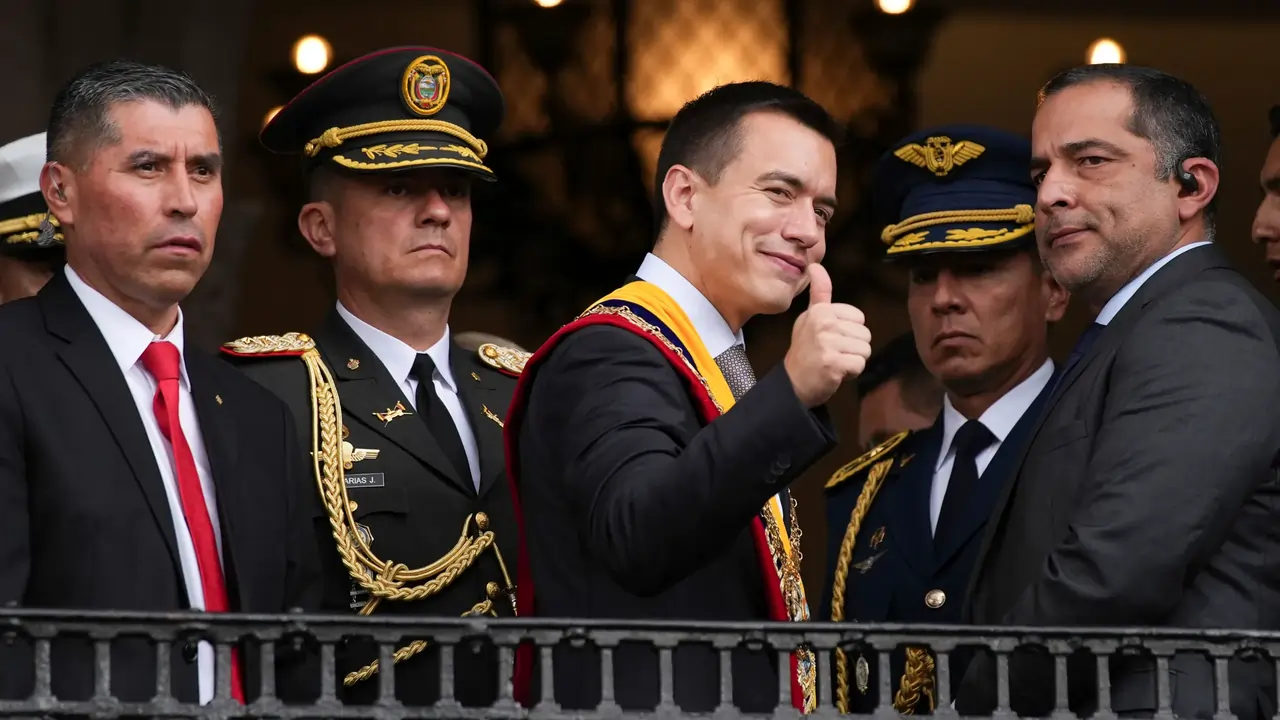
Quito: Ecuadorian President Daniel Noboa defended his government’s aggressive anti-crime strategy during his State of the Nation address, promising continued action against organized criminal groups tied to international drug trafficking networks.
Speaking before Ecuador’s National Assembly in Quito, Noboa said his administration would continue targeting gang leaders while expanding security cooperation with the United States.
The president highlighted the extradition of several organized crime figures to the United States as one of the clearest examples of his government’s hardline security approach.
He also pointed to the seizure of nearly 300 tons of drugs during recent anti-narcotics operations as evidence that Ecuadorian authorities are intensifying efforts against transnational trafficking organizations.
Noboa described public security as critical to Ecuador’s economic recovery and long-term social stability.
Ecuador has experienced a sharp increase in violence since 2021 as international cartels and local gangs increasingly turned the country into a major cocaine trafficking route connecting Colombia and Peru to Europe and North America.
The president defended the deployment of military forces, emergency measures and expanded police operations introduced after his government declared an “internal armed conflict” against criminal organizations.
According to Noboa, the scale of violence facing Ecuador requires extraordinary security measures.
He also emphasized growing cooperation with the United States involving intelligence sharing, joint anti-drug operations and broader security coordination.
Reuters previously reported that Ecuador and the United States launched expanded anti-narcotics efforts earlier this year as violence escalated across several provinces.
Noboa argued that his administration’s policies are beginning to produce broader results beyond security.
According to figures cited during his speech, poverty in Ecuador reportedly declined from 26% to 21.4% during 2025, while extreme poverty also saw modest reductions.
The address reinforced Noboa’s image as a leader focused heavily on militarized anti-crime policies while strengthening ties with Washington during one of Ecuador’s worst security crises in decades.
Violence and Drug Trafficking Reshape Ecuador
Ecuador’s security crisis has transformed the country from one of South America’s safest nations into one of the region’s most violent.
Organized criminal groups linked to international cocaine trafficking networks now exert influence over prisons, ports and parts of major cities.
The Associated Press reported that Ecuador recorded a homicide rate of approximately 50 per 100,000 people in 2025, among the highest rates in Latin America.
Much of the violence has been linked to gangs fighting for control over cocaine export routes through Ecuador’s Pacific ports.
The crisis has produced a series of shocking incidents in recent months, including prison massacres, decapitations, kidnappings, attacks on police officers and mass killings.
Groups such as Los Lobos and factions linked to Colombian armed organizations have rapidly expanded their influence as Ecuadorian institutions struggled to contain the violence.
Noboa’s administration increasingly relied on military deployments and curfews to restore order in violence-hit provinces.
Ecuador also expanded anti-drug operations near the Colombian border while deepening cooperation with U.S. security agencies.
Human Rights Concerns and Public Fear
Despite government claims of progress, human rights organizations and civil society groups have raised concerns about abuses linked to Ecuador’s militarized security strategy.
The Guardian cited reports alleging forced disappearances, torture, arbitrary detentions and civilian deaths during anti-crime operations.
Critics argue that some security actions blur the line between legitimate anti-crime enforcement and excessive use of force.
Advocacy groups and relatives of victims have demanded stronger accountability measures and independent investigations into alleged abuses committed by security forces.
The violence has also damaged Ecuador’s international image and tourism industry.
Reports indicate that many residents increasingly fear both criminal organizations and state security forces as violence spreads into neighborhoods previously considered safe.
Ecuador’s security crisis has therefore become one of the defining political and social challenges of Noboa’s presidency, shaping the country’s economy, foreign policy and daily life across the nation.