






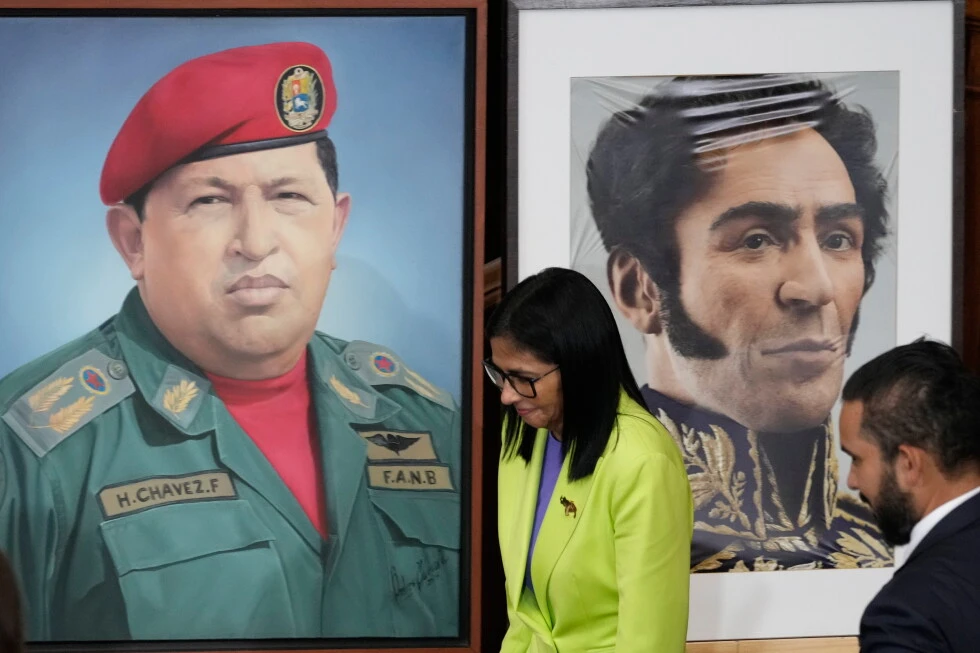
CARACAS, VENEZUELA – After nearly three decades of seemingly unshakeable ideological unity, Venezuela's ruling United Socialist Party (PSUV) is showing significant cracks, according to recent reports. The internal fissures, a stark departure from the cohesive front maintained since the ascent of the late President Hugo Chávez, are largely attributed to a strategic pivot led by Vice President Delcy Rodríguez, challenging long-held Chávez-era policies.
For 27 years, the Bolivarian Revolution, initially spearheaded by Chávez and continued by his successor Nicolás Maduro, has been characterized by a strong socialist ideology, extensive state control over key industries, and a robust social welfare system funded by oil revenues. The PSUV, formed in 2007 by consolidating various pro-Chávez movements, has been the political vehicle for this project, operating with a singular vision that has largely suppressed internal dissent.
The Genesis of Unity and its Ideological Pillars
Hugo Chávez, who first came to power in 1999, forged a powerful political movement based on anti-imperialism, national sovereignty, and the redistribution of wealth. His 'Socialism of the 21st Century' envisioned a society free from the dictates of neoliberal capitalism, with the state playing a central role in economic planning and social provision. This ideology became the glue that bound the diverse factions within the PSUV, creating a formidable political machine that dominated Venezuelan politics for decades.
Key Chávez-era policies included the nationalization of strategic industries like oil, telecommunications, and electricity; expansive social 'missions' providing housing, healthcare, and education; price controls on essential goods; and a staunchly anti-U.S. foreign policy that sought alliances with Cuba, Russia, China, and other like-minded nations. These policies, while popular among segments of the population, also laid the groundwork for future economic vulnerabilities, particularly their heavy reliance on oil exports and state-led economic management.
Economic Ruin Forges Pragmatic Shifts
The economic landscape of Venezuela began to drastically change following the global oil price crash in 2014, exacerbated by years of mismanagement, corruption, and an increasingly stringent sanctions regime imposed by the United States and its allies. The nation, once South America's wealthiest, plunged into an unprecedented economic crisis marked by hyperinflation, severe shortages of food and medicine, and a mass exodus of millions of its citizens. This dire situation has evidently forced a re-evaluation within the ruling elite.
Enter Delcy Rodríguez, a powerful and influential figure within the Maduro administration, who has emerged as a key architect of a more pragmatic, albeit ideologically contentious, economic strategy. While the government officially maintains its socialist rhetoric, Rodríguez has been instrumental in implementing de facto market-oriented reforms. These include a tacit acceptance of dollarization, which has seen the U.S. dollar become the primary currency for transactions, and the promotion of Special Economic Zones (SEZs) designed to attract foreign investment with favorable tax regimes and reduced regulatory burdens.
Such moves represent a significant departure from the strict state control and anti-capitalist stance that defined the Chávez era. They signal a recognition within parts of the ruling party that ideological purity must, at least temporarily, yield to the urgent need for economic recovery and stability.
The Ideological Fault Lines Emerge
The shift, however, is not without its detractors within the PSUV. Reports suggest a growing tension between those who champion these pragmatic adjustments – often labeled as 'Maduristas' or 'pragmatists' – and the 'Chavistas Puros' or 'hardliners' who view these reforms as a betrayal of Chávez's revolutionary legacy. The latter faction fears that such market-friendly policies will erode the socialist foundations of the Bolivarian project, reversing gains made in social equality and opening the door to capitalist exploitation.
These internal divisions are not merely theoretical debates; they have tangible implications for policy implementation and the future direction of the country. The hardliners likely advocate for a return to stricter state control, renewed emphasis on social missions, and a more confrontational stance against external pressures. The pragmatists, on the other hand, seem to prioritize attracting foreign capital, boosting domestic production, and stabilizing the economy, even if it means making uncomfortable ideological concessions.
Implications for Maduro's Leadership and Venezuela's Future
President Nicolás Maduro finds himself in a precarious balancing act. While he has publicly endorsed many of the reforms, he must also maintain the loyalty of the party's traditional base and the military, which remains a crucial pillar of his power. The extent to which these internal divisions challenge his authority or force him to lean more heavily on one faction over another will be critical in shaping Venezuela's immediate future.
The fracturing of the PSUV's unity could lead to several scenarios. It might empower a more technocratic and less ideologically rigid approach to governance, potentially paving the way for gradual economic liberalization and a more open engagement with the international community. Conversely, it could trigger deeper infighting, leading to political instability and making it harder for the government to implement coherent policies.
For the Venezuelan people, these shifts offer a glimmer of hope for economic improvement, but also raise questions about the future of social programs and the equitable distribution of wealth – core tenets of the original revolution. The long-term consequences of prioritizing economic pragmatism over ideological purity will undoubtedly redefine the landscape of Venezuelan politics and society for years to come.
As Venezuela navigates this complex internal struggle, the world watches to see if the ruling party can reconcile its revolutionary past with the pressing demands of its present economic reality. The path chosen by Delcy Rodríguez and her allies, and the party's ability to absorb these profound shifts, will determine not only the fate of the PSUV but potentially the very future of the Bolivarian Revolution itself.