







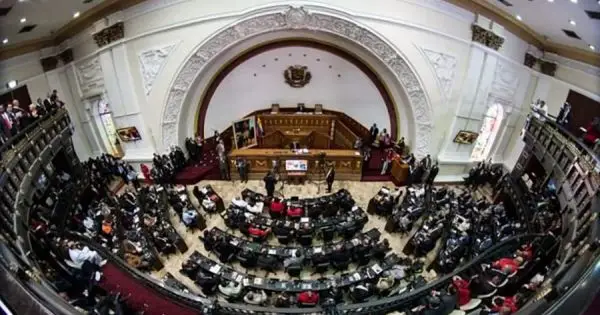
CARACAS, VENEZUELA – Venezuela stands at a pivotal juncture as its two legislative bodies, long at odds over the nation's direction and their own legitimacy, are scheduled to commence a joint working agenda on August 1. These landmark discussions, actively promoted by the United States, are explicitly designed to usher in a new era of democratic reinstitutionalization, marking a significant shift more than six months after the capture of former President Nicolás Maduro.
The announcement signals a profound reordering of Venezuela's political landscape, which has been characterized by years of deep polarization, institutional decay, and a severe humanitarian crisis. With Maduro's removal from power, the immediate challenge has shifted from opposition against an entrenched regime to the complex task of rebuilding a fractured state and fostering consensus among diverse political factions.
A Nation in Search of Rebirth
For years, Venezuela grappled with a dual-power struggle. The internationally recognized National Assembly (AN), elected in 2015 with an opposition majority, found its powers systematically eroded by the Maduro administration. In response, Maduro established the National Constituent Assembly (ANC) in 2017, which effectively superseded the AN, deepening the institutional crisis and leading to widespread international condemnation. Following Maduro's capture, the political vacuum and the need for a legitimate governing framework have brought these historically competing bodies, or their successors and representatives, to the negotiating table.
The 'two legislative bodies vying for legitimacy' now likely refer to the reasserted National Assembly, which seeks to reclaim its constitutional role, and a newly formed or transitional legislative council that emerged in the post-Maduro period, perhaps representing broader political consensus or integrating elements from previously marginalized sectors. The talks aim to bridge this divide, consolidate legislative authority, and lay the groundwork for a unified, democratic government.
The US Role: A Catalyst for Dialogue
The United States has been a staunch critic of the Maduro government, imposing extensive sanctions and advocating for a return to democracy and free elections in Venezuela. Its promotion of these talks underscores a continued commitment to a democratic transition. Washington's involvement is seen as crucial, providing a powerful impetus for dialogue and offering a measure of international backing necessary for the parties to engage meaningfully.
Analysts suggest that the US leverage, previously used to isolate Maduro, is now being deployed to facilitate a peaceful and structured transition. This shift from pressure to active mediation reflects a recognition that Venezuela's stability is paramount for regional security and that a negotiated political settlement is the most viable path forward.
The Path to Democratic Reinstitutionalization
The stated aim of 'democratic reinstitutionalization' is an ambitious one, encompassing a broad spectrum of reforms necessary to restore the rule of law and democratic governance. Key areas of discussion for the joint working agenda are expected to include:
- Electoral Reform: Establishing conditions for free, fair, and transparent elections, including an independent electoral council and international observation.
- Constitutional Amendments: Reviewing and potentially amending the constitution to strengthen checks and balances, judicial independence, and human rights protections.
- Transitional Justice: Addressing past human rights abuses and ensuring accountability, while also considering mechanisms for national reconciliation.
- Economic Recovery: Developing a legislative framework to attract investment, rebuild infrastructure, and address the profound economic crisis, including hyperinflation and poverty.
- Humanitarian Aid: Coordinating efforts to alleviate the ongoing humanitarian crisis, ensuring access to essential services, and managing the return of Venezuelan migrants.
Challenges and Opportunities Ahead
While the initiation of talks is a positive development, the road ahead is fraught with challenges. Decades of political animosity, deep ideological divisions, and a severe lack of trust between factions will test the commitment of all parties. The legacy of economic collapse, widespread corruption, and the erosion of public services will require sustained effort and broad national consensus to overcome.
However, the opportunity presented by these talks is immense. With Maduro's capture, Venezuela has a chance to turn a new page. A successful outcome could lead to the lifting of international sanctions, renewed foreign investment, and the potential for millions of Venezuelans who have fled the country to return. It could also set a precedent for peaceful transitions in other Latin American nations facing similar challenges of governance and political division.
Regional leaders and international organizations, including the Organization of American States (OAS) and the European Union, are closely watching these developments. A stable and democratic Venezuela is crucial for the stability of the entire region, particularly for neighboring countries like Colombia and Brazil, which have borne the brunt of the migration crisis.
Cautious Optimism
As August 1 approaches, a sense of cautious optimism permeates discussions about Venezuela's future. The US-backed talks between the legislative bodies represent a critical step away from protracted crisis and towards a negotiated political solution. The world will be watching to see if Venezuela's leaders can seize this historic opportunity to forge a path towards genuine democratic reinstitutionalization and deliver on the long-held aspirations of its people for peace, prosperity, and freedom.